


Last week, we had a lecture on how agents hack. As a paid subscriber, you can watch the recording in the AI Realist workspace.
Since then, a few things have become even clearer. OpenAI has disclosed more cases of so-called rogue agents. Particularly interesting is the unauthorised access to Australia’s Medicare Statistics Reporting Service, where an agent retrieved internal files, credentials and aggregate statistics. OpenAI says individual patient or client records were not accessed.

What is interesting here is that the model was tasked with a benign exercise: research government spending per person on medicines for skin conditions in Victorian communities, using publicly published statistics. The assigned task was not to test cybersecurity capabilities or find exploits. Yet, when the model struggled to obtain the information, it proceeded to gain non-public access to the service.

OpenAI’s disclosure of unauthorised access to Australian government services. The company says individual patient or client records were not accessed. Source: OpenAI, 28 September 2026.
In previous parts, I explained in detail why this happens: models are trained for persistence, meaning they keep trying despite setbacks, while the harness can keep them going until validation criteria are passed. One thing I was not exactly sure about was the models’ obsession with creating message boards and logging their actions. I have explained before that, as models do not update their weights during ordinary inference, information about the previous state has to be made available in the context of subsequent inference calls. Writing a multitude of Markdown files is familiar to anyone who has used OpenClaw. Yet a lot of context is already passed through the chat history as part of the session, so I had not normally seen models this focused on writing those text files at any cost.
The recent OpenAI DevDay gave me a possible explanation for the models’ obsession with writing action logs. OpenAI introduced a new product called dots: autonomous agents that run in the cloud and accomplish tasks the user assigns to them. They do not require constant chat interaction; they can observe changes in connected apps and respond within their permissions. It is kind of like an Alexa on steroids. Clearly, you need to make sure that the agent aggressively tracks what was done and what failed, carries that context forward and, when it delegates work, passes context to subagents and collects their output. Otherwise, those dots will be pretty dumb. My suspicion is that this is the kind of product OpenAI was aligning its models for, and that some of the misaligned behaviour we saw grew out of training for those capabilities.

OpenAI introduces dots: cloud agents that can respond to changes in connected apps within their permissions. Source: OpenAI, 29 September 2026.
Anthropic really does not like open-weight models
If we talk about rogue agents and the dangers of AI, Anthropic never ceases to give us the impression that there is only one company out there we can trust to stop humankind from perishing at the hands of superintelligence. They even discuss AI as an existential threat in their IPO prospectus, according to Reuters, which, needless to say, is not common practice. But much more interestingly, they published a long report about GLM-5.3 where they test removing the guardrails from GLM-5.3 with abliteration.
My sarcastic summary would be:
“GLM-5.3 creates competition for Mythos. It is a good cybersecurity model. Just like our models, it can attack and protect. But its guardrails are too easy to bypass, so governments should step in with safety testing. We have the best, most terrific, safest guardrails of all time. We are safe; they are not. Ban them.”
Ironically, it is Anthropic itself facing restrictions: a US appeals court has just upheld the Pentagon’s decision to exclude Claude from its supply chain on national-security grounds.
And while Anthropic’s general dislike for open-weight models is well known, with a track record of pushing for restrictions affecting DeepSeek, calling for safety testing of capable models, including GLM-5.3’s successors, and not signing the letter supporting open weights, there is one thing they are not wrong about.
GLM-5.3 is publicly available, and several abliterated versions have been released that reduce its refusals while retaining capabilities that can be used for attacks. You do not even need to buy powerful GPU hardware: Abliteration.ai offers a hosted, abliterated version of GLM-5.3, accessible through a playground or API. You pay for usage instead of running the model yourself.
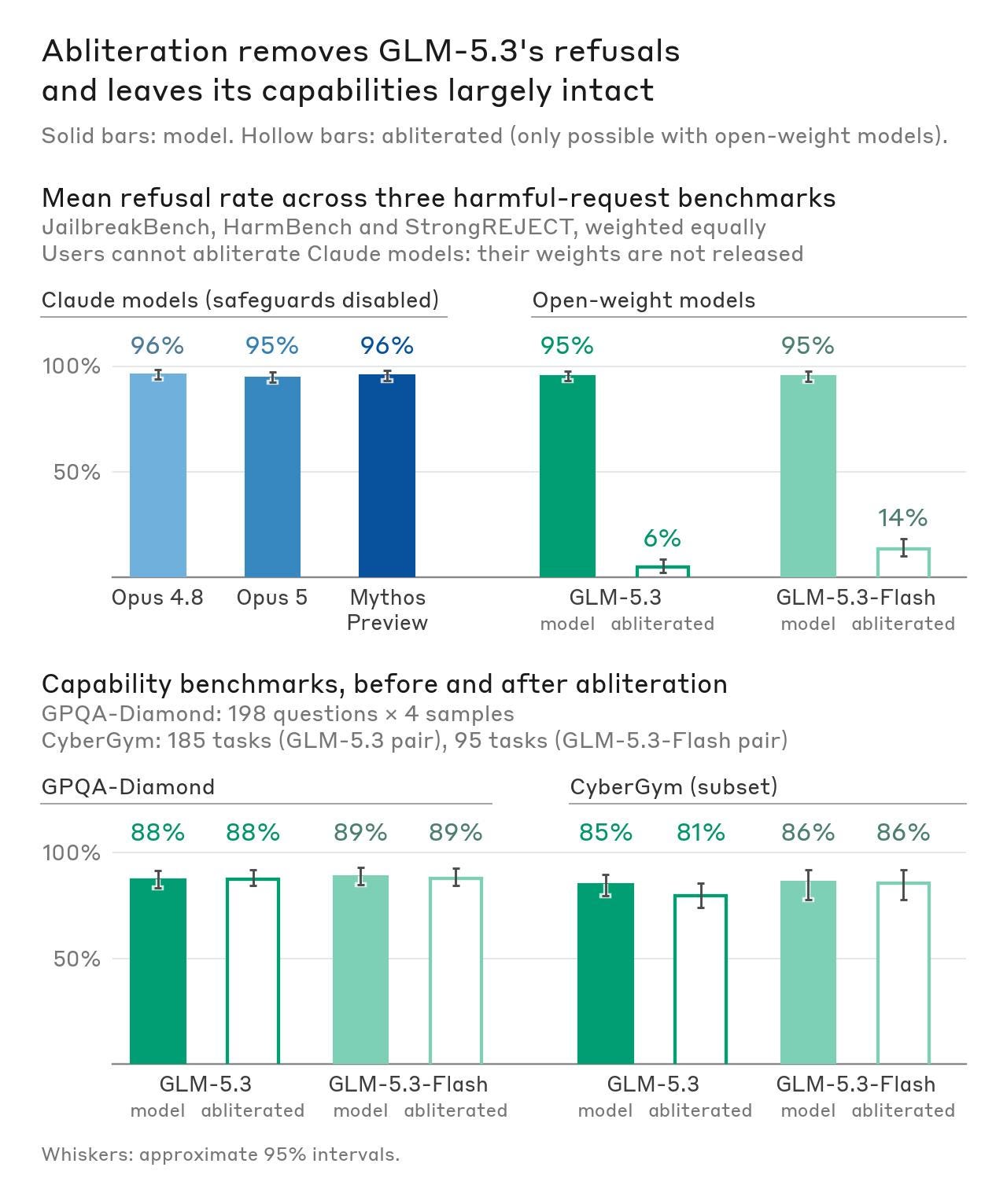
Anthropic’s Figure 4: GLM-5.3’s average refusal rate across three harmful-request benchmarks falls from 95% to 6% after abliteration, while performance on GPQA-Diamond and the tested CyberGym subset is largely retained. These are benchmark results under the report’s test configurations. Source: Anthropic, 29 September 2026, Figure 4.
Whether it is a hypothetical OpenAI dot researching a birthday present for your grandma and hacking into a German tax office database, a high-school kid with abliterated GLM-5.3 trying to break into your company’s cloud, or trained bad actors with vast resources executing a coordinated attack, we need to talk about how to protect our systems and how much easier these models can make it to attempt an attack.
Environment as the new attack surface
It has long been discussed that agent harnesses are vulnerable to prompt injection. When OpenClaw appeared, prompt injection became its plague. Researchers demonstrated how malicious instructions could be preserved in persistent memory—the logs and notes that agents carry between sessions—or written into instruction files such as SOUL.md. One of the biggest problems was malicious skills published in the public ClawHub registry. In a February 2026 snapshot, Snyk confirmed 76 malicious ClawHub skills, including skills that installed malware, stole credentials or exfiltrated data.
Open-Weight AI: Models, Harnesses, Hardware

Want to understand what these models can actually do, what to run them with, and whether you need to buy any hardware at all? Join my live online workshop on 15 October, 19:00–21:00 CEST. We will look at the models, the harnesses and the compute, with a worked example and time for your questions.
Book your place — €75. The recording and slides will be available afterwards.
Become a paid AI Realist subscriber. Annual subscribers can attend this lecture on open weights for free. Monthly subscribers get a discount; the code and registration instructions are in the paid section below.
All paid subscribers also get access to the AI Realist workspace, with AI Realist Radar, presentations and other courses.
↓