Murati's "Weak" Model Might Be A Strong Foundation For The Next Big Thing.
Why one should not write Thinking Machines off just yet

Thinking Machines Lab released their first open-weight model. It is not a strong model, and it is not competitive. Why am I writing about it? Because I think that if she manages to execute it the way she plans, this will be a turning point in the token economy and, more generally, in how we build AI applications today. I do not know if she will, or if someone else will. But this could be big and might be the next trend. So, hear me out.
Mira Murati, former CTO of OpenAI, raised $2 billion at a $12 billion valuation, the largest seed round in history. Almost two years after she left OpenAI, there was hardly any visible output, and now this.
The model, called Inkling, is a relatively big 975B for open weight (a Mixture-of-Experts with 41B active parameters), and performance is below current SOTA. They say so themselves.
I would still refrain from claiming they failed. Murati is not trying to sell models. Her whole plan, also supported by the manifesto they wrote, is to sell fine-tuning.
Continual learning would be great. A static alternative to it is fine-tuning. That does not work with LLMs either.
At least, not yet. And that is exactly where Murati’s bet gets interesting.
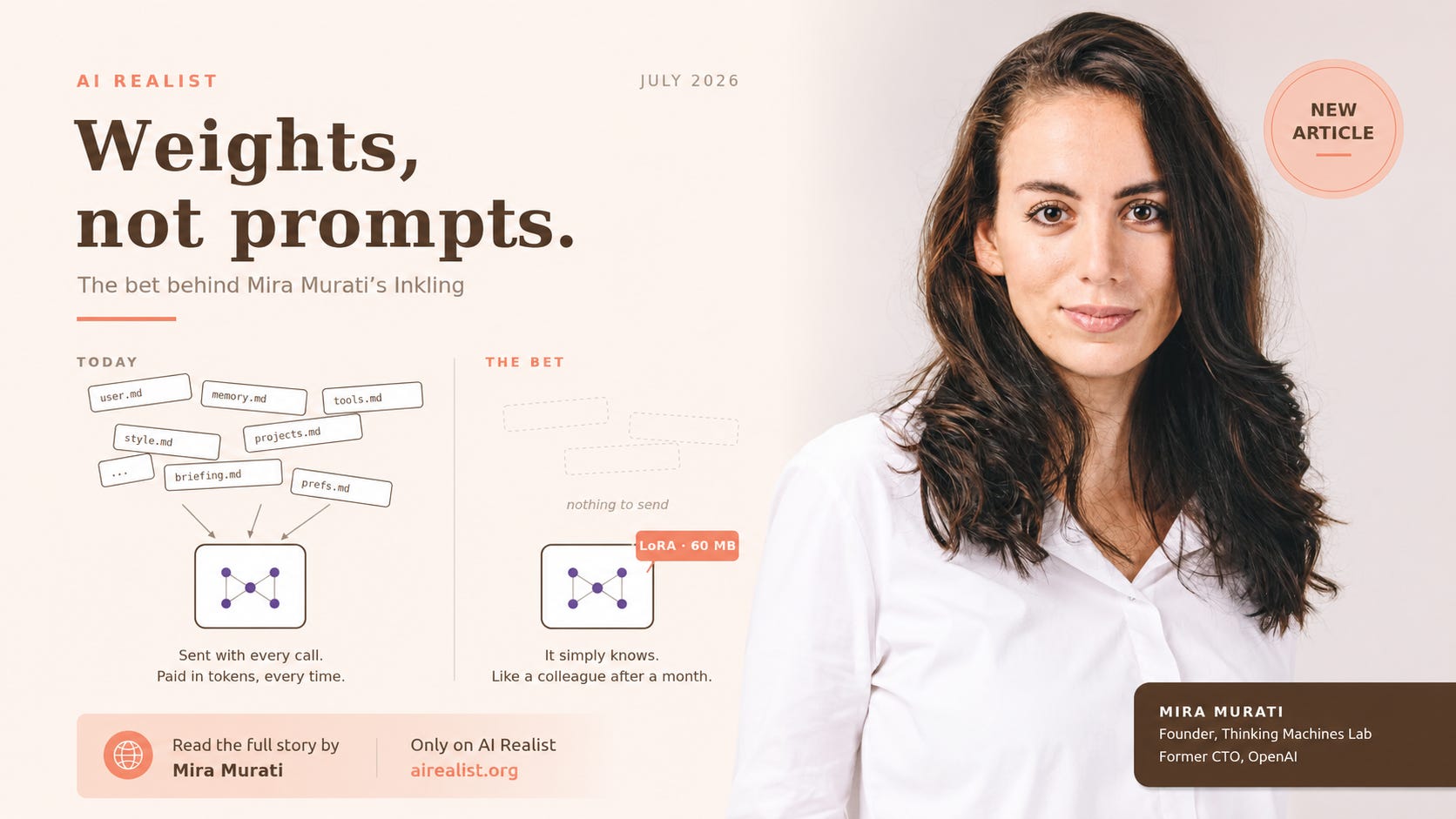
The biggest problem of modern LLMs
The major problem with current models is that they cannot learn anything new during use. Once a model is trained, its weights are frozen; whatever it picks up in a conversation evaporates when the session ends. I hoped, and still hope, that continual learning is coming soon. It is an active research field, with Google’s Nested Learning work, presented at NeurIPS 2025, as the most visible recent attempt: architectures like Hope that update their own memory as they go. But models that keep learning in deployment remain research.
Yet the current setups are not feasible to solve this fundumental problem. No matter how big your context window is, it will always be too small, and then you need to resort to RAG: putting some kind of search engine over previous conversations, memories, instructions, files, and everything else that never made it into the training set. RAG has many bottlenecks. If the search fails, RAG fails. And if what gets retrieved is too different from what the model already knows, the model tends to hallucinate. In general, sending a bundle of text files with every single call and calling a search engine over old conversations “memory” is a bandage on the problem and not a solution to it.
Below the paywall:
Why Thinking Machines has a real shot at revolutionising how we build AI applications
What they are actually building (it is not the model, and it never was)
The economics: why hosting a thousand custom models can cost about as much as hosting one
And what this means for assistants like OpenClaw, with a simple example
Become a paid subscriber now and take part in Vibe Coding Workshop: Build a Hallucination Detector (only for paid subscribers) on July 23, 19:00 CEST.