


This is a very special article—a two-part collaboration with AI Health Uncut by Sergei Polevikov! The other part of the series is:
GPT-5 Kills RAG. As For Healthcare, It's OpenAI's Next Big Gamble
Sergei is doing God's work, exposing the overpromises and empty hype from AI companies with his expertise in AI and its applications in healthcare. His writing have the perfect balance: deep technical details that experts can scrutinize, paired with clear explanations for everyone else.
In AI for healthcare, too many companies sell "innovations" that give false hope — claiming their transformer models could one day extend your life or save your loved ones — when they're really just chasing your data and dollars. That's why it's crucial to arm the public with the truth. Subscribe to AI Health Uncut for unfiltered, eye-opening analysis, and share it with your friends and colleagues! Check out the introduction video by Sergei Polevikov

The content of the article:
Introduction
Promises of AI Companies
The Challenge of Data Acquisition
Advancing LLMs' Capacity for Novel Scientific Discovery and Hypothesis Generation
Ethical and Transparent AI Design
Developing Hybrid or Novel Architectures Beyond Pure LLMs
Introduction
OpenAI has clearly shown that they want to get into healthcare. In May they introduced HealthBench, a new benchmark to measure the capabilities of AI in health. AI Health Uncut has already done a great breakdown of how easy it is to beat your own benchmark if you train on it: OpenAI's gpt-oss Proves Healthcare AI Still Needs Human Babysitters
In July, they announced an AI clinical copilot , that studied a whopping 40,000 patients visits. Finally, during the stream of GPT-5 launch, Sam Altman made it very clear that healthcare is their next target.
It is not the first time a company has tried to do it. The infamous IBM Watson that won Jeopardy! in 2011 almost immediately announced that it was now going to build an assistant for doctors. They flopped badly and learned the hard way that healthcare possesses immense challenges for AI adoption:
Expectation of near-perfect accuracy — just as you do not need a calculator that is only right 70% of the time, even less do you need a doctor that hallucinates diagnoses
User acceptance — doctors are not particularly eager to turn to a chatbot to help them do a diagnosis. If a bot spits out nonsense, like any other expert, the doctor will roll their eyes and never use it again
Explainability — transformers are not explainable. Their post-factum rationalizing is rather misleading, is there to create an illusion of transparency, and might have nothing to do with what actually led to the decision
Regulatory hurdles — particularly in the EU such as the EU AI Act, various audits, and whatnot can significantly slow down the time to market
Lack of training and evaluation data — medical datasets are notoriously hard to acquire, and for many years AI for healthcare used synthetic datasets.
The cautionary tale of IBM Watson ended with tragedy: after a decade of trying, overpromising, and failing, IBM sold its Watson Health assets to a private equity firm, effectively ending its ambitious healthcare adventure.
Now we have a new self-proclaimed leader in the AI healthcare market—OpenAI. But, so far, OpenAI mostly leads in overpromising and hyping up its capabilities.
The awfully unethical presentation during the livestream where the former cancer patient was praising the model that was comparing doctors’ advice and giving her medical guidance on which advice to choose [source]. My opinion is that it is nothing but a data collection attempt — OpenAI hopes to encourage desperate patients to turn to their bot and start uploading their scans, analysis reports, symptom descriptions, etc.
They also get prominent doctors and cherry-picked use cases to strengthen their use case: overview by AI Health Uncut
Why would they do that? Well let’s dive in what happen behind the scene of training a “virtual doctor“.
Promises of AI Companies
Let us first keep the receipts and collect a few promises made by AI companies for healthcare, then we will discuss what they need to achieve them.
Dario Amodei predicted that AI could substantially increase human lifespan:

Sam Altman claimed that GPT-5 could outperform most doctors:

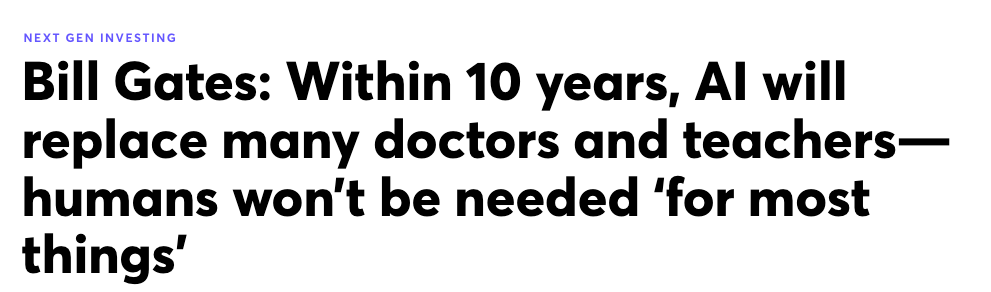
Bill Gates suggested that AI might soon reduce the need for doctors. Mass media quickly picked up on it and rephrase his statement in even more extreme way that it actually was:
There are many more examples like this, but let us consider what is needed to actually achieve these goals.
