


Our memory is very selective and sometimes in strange ways: we might remember the color of the wallpaper in our classroom when we were 10 but have no idea what we were wearing yesterday. We get so much information on a daily basis that without intentionally focusing on what is there to know and remember, we might miss important developments and memorise something that will barely have any impact. This is particularly relevant with AI — every day tools and models are coming out and a lot of informational noise is presented as sensational.
It is absolutely unimportant to remember that Anthropic released Opus 4.6 a few days ago and OpenAI released GPT-5.3-codex half an hour later.
But there is one tool that showed us something very interesting, and this is something you might want to remember. I am talking of course about Clawdbot / Moltbot / OpenClaw.
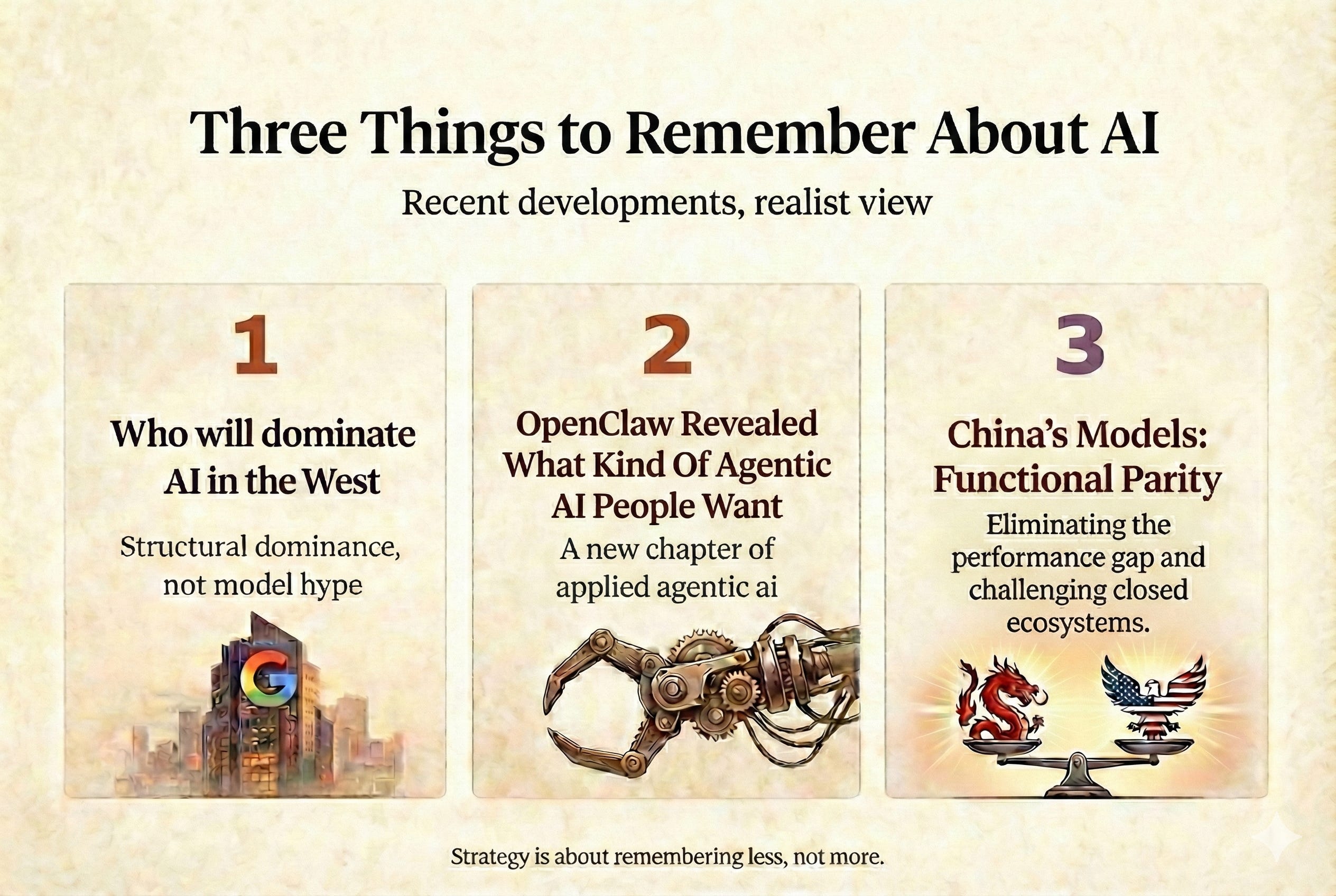
The fascinating thing about OpenClaw is that it completely lacks any technological innovation. In fact, the tech stack behind it is absurdly trivial and uninspiring. Yet, users loved it. So the second thing to remember about recent advances in AI: OpenClaw showed how Agentic AI can be useful for tasks others than vibe coding.
The third part will follow shortly. You can read part one here. The third part will be the most impactful and controversial discussion out of the three. So the third thing to remember is that “Chinese open-weight models have just achieved functional parity with US proprietary models, eliminating the performance gap that once justified closed ecosystems.“ Many might not have realised it yet, but as it will get more and more obvious, this is going to have great implications for the AI-based economy, providers’ choice and the application of AI.
The Boring Technology Behind OpenClaw
OpenClaw is not bringing any new models, genius prompts, fine-tuning, or anything along those lines. In fact, it relies on weaker and cheaper open-weight models.
It officially recommends MiniMax M2.1, and the most used model for OpenClaw currently is Kimi K2.5.
Why not Claude? Why not Gemini or OpenAI? The answer is simple. Those models would render OpenClaw unusable because of the costs. Would OpenClaw perform better with a stronger Opus 4.6? Most certainly it would, but it would bankrupt you.
Thus, we use models that are not as performative but ten to twenty-five times cheaper.
OpenClaw burns a lot of tokens simply because it sends massive prompts in each turn.
If you look up what is in OpenClaw configurations, you will see things like SOUL.md, USER.md, multiple SKILL.md, various MEMORY.md files.
OpenClaw is praised for being able to “remember” who its user is and what they talked about before. This is not because the creators had a breakthrough in test-time training. This is simply because they save every session in a text file.
Every session starts by injecting bootstrap files - AGENTS, SOUL, TOOLS, IDENTITY, USER, and HEARTBEAT- into the system prompt. If a MEMORY.md exists, it is loaded too. Daily memory logs and skill instructions are loaded on-demand. Still, even with this design, the base system prompt, tool schemas, and workspace files consume roughly 20,000 to 40,000 tokens before your first message. So even if you just say “hi”, your prompt, except for your “hi”, will carry all of that context.
(The overview of OpenClaw architecture. The video is generated in VS Code, by generating slides with Tikz, the voice over was added directly by Github Copilot by utilising ViduAI API, the first and the last slides were beautified with ViduAI API as well. The faithfulness of diagrams was compared against the Github OpenClaw Repo with Opus 4.6 using Github MCP server)
The agency of OpenClaw comes from utilization of already implemented tools, e.g. MCP servers, the ability to execute bash commands, and similar. In fact, it is not new for those who use GitHub Copilot. GitHub Copilot can also run bash commands, use MCP tools, write code, and execute it. The difference is that GitHub Copilot is used for coding tasks and is not accessible remotely but only through your IDE. It is easy to share OpenClaw skills - in fact there is a website called ClawHub with thousands of skills created by users. You can simply download a skill in your OpenClaw - it might be a useful skill or a malicious command hidden in the assets - noone knows.
But here we come to another interesting point — this is something we have already heard from the infamous MIT report on why 95% of AI PoCs bring no ROI. Users do not use AI that is not integrated into their workflows. What is one of the most appealing things about AI-assisted coding tools? They are in the same environment where coders would normally work.
OpenClaw enables easy connections to commonly used messengers: WhatsApp, Telegram, MS Teams, etc. This integration fits well into users’ workflows. They do not need to install a separate tool, navigate between many bots, or even go to a certain website. This is convenient.
The Noise About OpenClaw
Unfortunately, a lot of useful observations that could have been made from OpenClaw drowned in the noise.
You can also watch a presentation with the summary of the article behind the paywall:
Subscribe so you do not miss it:
Paid subscribers get:
Priority answers to your messages within 48-hours
Access to deep dives on the latest state-of-the-art in AI
Free access to quaterly AI realist training. Next training: Directing Videos with AI
How to Become an AI Media Producer
Founding members:
A 45-minute one-on-one call with me
High-priority personal chat where I quickly reply to your questions within 24-hour
Support independent research and AI opinions that don’t follow the hype.